Chapter 3 begins
Back to Cid this week

Good day, lovelies. I hope your holiday weekend has been splendid, and that you’ve gotten some refreshment from it. Things have been a bit mad for me, but I’m slowly getting it under control.
Today’s section kicks off Chapter 3, in which the narrators meet. We start with Cid. I’ve previously shared this section on Substack as a kind of standalone story with the Soaring Twenties Social Club, titled Cid in the Architecture. I’ve tweaked it a little since then. Please enjoy, and as always, share if you think others would also enjoy.
Chapter 3
The Inevitable Lightness of Meeting
“We are ka-tet. We are one from many.”
-Roland Deschain, The Dark Tower series, by Stephen King
ONE
Cid
It was just a job. Jobs, I guess, would be more accurate. I’d been out of Mil for a while, out of the service. Whatever you call it these days. I was out of the killing business, is what I’m getting at. Just driving a cab in Boston, trying to keep ahead of the zillion other people trying to do the same thing. I was lucky, I guess, that the whole self-driving-car revolution never really had the chance to take.
I had a good thing going, though. Being a ‘borg has its benefits. People trust a driver that looks like a robot, for some reason. More than they would, I think, if I looked like a jarhead vet. It’s weird, because I know objectively I can also look pretty terrifying. All metal and menace, Eden used to say, though my face-screen helps soften that up a bit. Krysis said I looked like a Transformer.
But I’m getting ahead of myself.
Taxicab. Not even a fancy flying one, just the usual. Old school, like me. That’s another advantage I had, for a certain kind of customer. The military driving experience, too. You want to get from Back Bay to Roslindale in 15? No problem. I mean you might leave your stomach in the backseat, but I had affordances for that. Plus I can’t smell anymore, so I’ve got that going for me.
Upshot is, word got around, I had a network of people who’d call me directly besides street-side pickups, et cet. It was a good gig.
One night I picked up this woman. She had a look I recognized, like she was jumping into my cab to escape some immediate danger, and like she was used to doing it. She didn’t hop in and slam the door yelling “go go go” or anything like that. She was slick about it. But I could tell as soon as she closed the door that it was time to pull away fast.
“Longwood,” she said. “I’ll tell you the street when we’re closer.”
I gave my usual metallic thumbs-up, a gesture I’ve found puts people at ease. Then she spoke again.
“Can you lose a tail?”
I glanced in the rearview and saw it. “Consider it done,” I said, and screeched out of there.
I’ll be honest with you: I don’t remember exactly who the tail was, how I lost it, what she was running from, that first time. I don’t even remember, frankly, if she told me. I just took care of it, and by the time we knew each other better, it didn’t seem important. The important bit was that we got to the Longwood area, tail-less, and she told me where to pull over. I figured she’d pop out, pay me on the run, and keep moving. But instead she paused. I scoped the rearview, and saw something I didn’t expect. Fear.
You might think it’s strange I didn’t expect it. After all, I’d just screeched that car from the Port to Longwood in the space of about five minutes. There’d probably been a few near-misses back there. And she was being followed. Fear—followed by relief they survived the trip—is an expression I’m used to seeing in my cab. Something about her, though. Right from the beginning, she had the the look of someone who’s not afraid of anything.
She was now, though. “Can you be back here in ten minutes?” she said, her eyes on the warehouse outside her window, scanning. I must have given her my equivalent of a strange look. “I’ll pay you,” she clarified.
“Yeah, I can do that. Or I can wait here.” I didn’t like the odds I saw playing over her face. I knew she wanted me out of sight for as long as she needed to do whatever fell errand she had in there, but it felt all wrong. I tried for a cheery tone as I added, ”Or you could just not go in there.”
Her eyes shot to me then, narrowed, deep brown, the fear gone or buried. “Mind your business, ‘borg.”
“Yes’m,” I said, turning forward and gripping the wheel. Yeah, I was concerned for her, even then. I don’t know why. Sometimes you just meet somebody and you know, you know? I clearly wasn’t going to stop whatever her mission was, though. Sometimes you just gotta let the fare go in there and get shot.
She got out of the car slowly, looking around, her posture and bearing and caution not military, but nearly — familiar in that way. She ran one hand over her close-cropped hair, black on the sides, bleached to pale yellow on top. The other patted down her left hip, where she was probably keeping whatever she was here to deliver.
She took one more deliberate, shoulder-squaring breath, and then she moved.
I knew that breath. I hoped I’d see her again. I took one more look toward her, then pulled off, not too fast this time, staying inconspicuous. I turned as soon as I was able, and slid into mid-day, mid-town traffic.
I’d gotten a couple stealth upgrades when I first got the cab. Wasn’t sure why. Guess I was paranoid, wanted to have it just in case. (Of what? Back then I didn’t think about it too hard.) I didn’t have full blend or anything like that, but I had the refractor paint so I could change colors with a button-touch. Pretty slick. Didn’t hide your plate, but if someone was looking from a distance and wondered if that was the same cab they just saw, say, ten minutes ago, then the cab being blue instead of yellow usually would cover me. I made the change right after I turned the next corner into an alley, nobody behind me, then sped out the other end quick as I could.
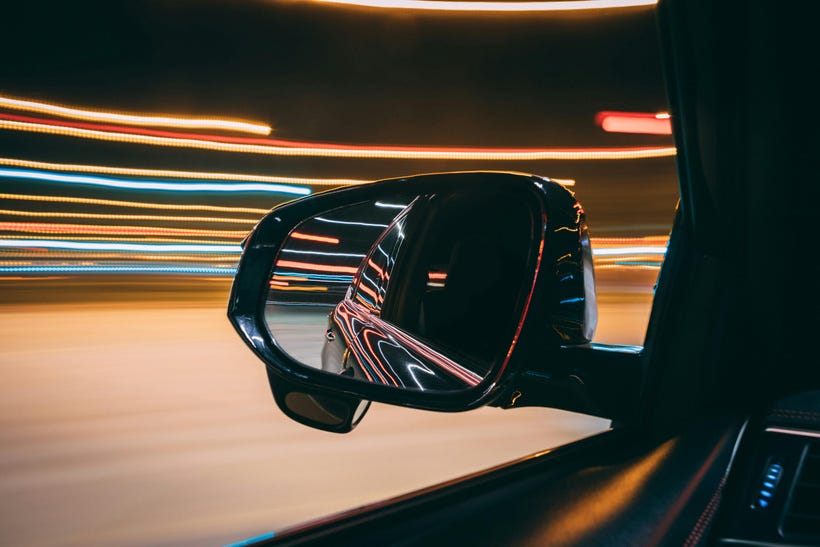
Out on the Riverway I melded with the scenery, the tick-tock flash of cars weaving through the three lanes, alive with malice and rush and not seeing me at all. Friendly sideswipes nobody notices anymore since all Boston cars got side bumpers and driving became an even more competitive sport than it was back in the day when they sort of fixed the potholes sometimes. Nudges and love taps. Sliding around the curves like hovercraft, schooling like fish, a breathing collective metal organism snaking through concrete. I made a game of it: could I set the traffic’s pace, lead the charge, be the head of this dragon? How much could I slide in and among, around, how fast, could I make them all follow me?
I took five minutes to sink into the blur, to be one with it. Nothing did so much to calm me down.
I took a sharp left out of my reverie and started to loop back toward the building where I’d left her, hoping, almost praying now. Not for the fare; don’t imagine it’s like that. I wanted to know that she was okay. For all the people I’d lost in my day, I’d never lost a passenger.
I screeched up to the curb where I’d left her, just in time to see her belting out of the building, carrying a small case. Wait no: a cooler. I saw her jerk back for a microsecond, not recognizing the car, but then she saw me and hauled the back door open again.
This time she said it: “Go, go, go, go!”
I went.